

Daily Habits of Six-Figure Freelancers: Platform Choices Compared
When you’re building a six-figure freelance career, the daily habits you adopt matter just as much as your skills. But here’s what many freelancers miss: choosing the right tools, platforms, and approaches often comes down to understanding the trade-offs. This list examines the daily habits of successful freelancers through a comparative lens, weighing the pros and cons of different approaches. You’ll see how top earners make decisions about where to invest their time, which platforms to prioritize, and what trade-offs they accept to maximize income. Whether you’re scaling up or just starting to think bigger, these insights will help you make smarter choices about your daily routine.
- Choosing Specialized Marketplaces Over General Platforms

High-earning freelancers often debate between general platforms like Upwork and specialized marketplaces like Legiit. The trade-off is clear: general platforms offer more volume but fierce competition and lower rates, while specialized platforms connect you with clients who value expertise and pay accordingly.
Legiit focuses specifically on digital services like SEO, content creation, and marketing, which means less time competing with low-cost generalists. The client pool understands what quality work costs. The downside is a narrower audience, but for freelancers in the right niches, the quality of leads far outweighs the quantity game. Many six-figure earners report spending just an hour daily managing their Legiit presence versus three to four hours hustling on broader platforms, with better revenue per hour invested.
- Morning Deep Work Versus Scattered Availability
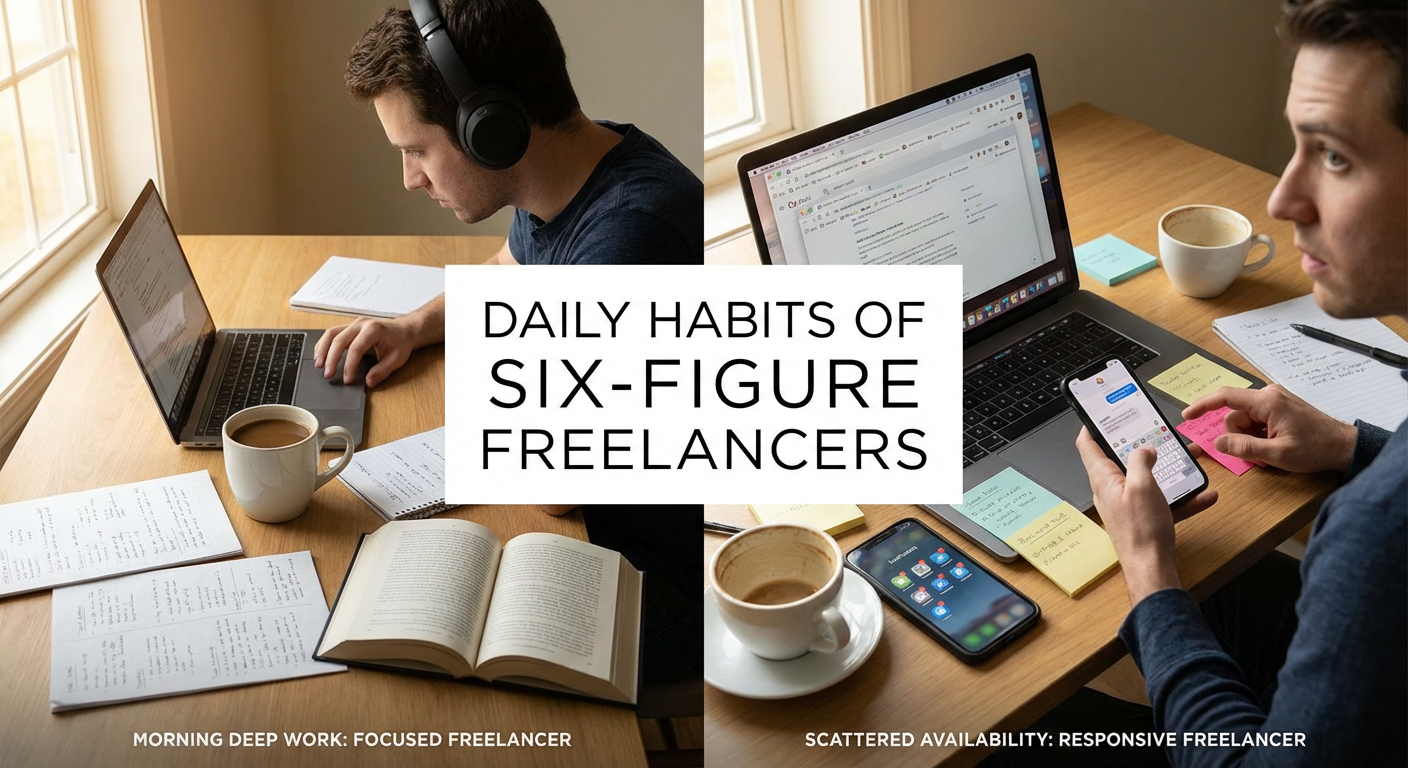
The debate between blocking off morning hours for focused work versus staying available for client calls represents a fundamental choice. Deep work advocates protect their first three to four hours for high-value tasks like strategy, writing, or development. The upside is superior output quality and faster project completion. The downside is potentially missing real-time client communication.
Freelancers who prioritize availability throughout the day maintain stronger client relationships and faster response times. However, they often report lower quality work and longer project timelines due to constant interruptions. Six-figure earners typically lean toward protected morning blocks, accepting that some clients may need to wait a few hours for responses. They’ve found that the quality improvement justifies occasional scheduling friction, and premium clients respect boundaries more than budget clients do.
- Retainer Models Compared to Project-Based Work
The retainer versus project debate shapes daily workflow dramatically. Retainers provide predictable income and deeper client relationships but can feel restrictive and may limit your ability to take on higher-paying one-off projects. Project-based work offers flexibility and the potential for premium rates but creates income volatility and constant sales pressure.
Successful freelancers often blend both approaches, dedicating mornings to retainer work that covers baseline expenses while reserving afternoons for project work that pushes income higher. The hybrid approach demands more calendar management and context switching. Pure retainer models simplify daily planning but may cap earning potential. Pure project models maximize per-hour rates but require constant pipeline management. Most six-figure freelancers maintain at least 40 to 60 percent of income from retainers to reduce stress while leaving room for growth.
- Proactive Outreach Versus Inbound Marketing
Daily lead generation splits into two camps: active outreach through cold emails and networking versus passive inbound through content and SEO. Outreach delivers faster results and direct control over pipeline volume. The downside is time intensity and potential burnout from rejection. It works exceptionally well for new freelancers who need immediate cash flow.
Inbound marketing through blog posts, case studies, and social content takes months to build momentum but eventually creates a self-sustaining pipeline. High earners report spending less than 30 minutes daily on lead generation once their inbound systems mature, compared to two hours for outreach-dependent freelancers. The comparison shows outreach wins for speed while inbound wins for sustainability. Many successful freelancers start with outreach to fund their business, then gradually shift time toward content creation as inbound gains traction.
- Niche Specialization Versus Broad Skill Sets
The generalist versus specialist debate affects daily work dramatically. Specialists command higher rates and face less competition but risk market shifts making their skills less relevant. They spend daily time deepening expertise in a narrow area, which can feel limiting but allows premium positioning.
Generalists access more opportunities and adapt easier to market changes but struggle to differentiate and often accept lower rates. Their daily learning is broader but shallower. Six-figure freelancers overwhelmingly favor specialization, with most reporting that narrow focus doubled their rates within 18 months. The trade-off is accepting that you’ll turn down work outside your niche, which feels uncomfortable initially but ultimately saves time and increases profitability. The daily habit here is saying no to misaligned opportunities, which generalists find harder to do.
- Time Tracking Tools Compared to Intuitive Estimation
Freelancers split between rigorous time tracking software and intuitive project estimation. Time tracking provides concrete data for pricing decisions and helps identify which tasks drain profitability. Tools like Toggl or Harvest take minutes daily to maintain and reveal patterns you’d otherwise miss. The downside is feeling monitored by your own system and the administrative overhead.
Intuitive estimators rely on experience and gut feel, saving administrative time but risking underpricing or scope creep. High earners who track time report 15 to 25 percent higher effective hourly rates because data exposes unprofitable tasks and clients. Those who estimate intuitively save roughly 30 minutes daily on tracking but admit to occasionally mispricing complex projects. The comparison suggests tracking wins for newer freelancers building pricing confidence, while experienced professionals can sometimes rely more on intuition without significant loss.
- Batching Similar Tasks Versus Mixed Daily Variety
Task batching means grouping similar activities like writing all blog posts on Tuesdays or handling all client calls on Thursdays. The benefit is reduced context switching and deeper focus, leading to faster completion and better quality. The downside is less daily variety, which some find monotonous, and reduced flexibility for urgent client needs.
Mixed schedules offer variety and responsiveness but fragment attention. Freelancers report that batched days feel more productive but sometimes less collaborative. Six-figure earners typically batch admin tasks and deep work while keeping client-facing activities more fluid. The comparison reveals that complete batching works best for introverts doing heads-down work, while partial batching suits those who thrive on variety. Most successful freelancers batch at least their administrative and communication tasks, saving one to two hours daily through reduced setup and teardown time.
- Premium Pricing Versus Competitive Rates
Pricing strategy shapes daily client interactions and project selection. Premium pricing means charging top-tier rates, which filters for quality clients and reduces project volume. You work with fewer, better clients who respect your time and expertise. The trade-off is a smaller prospect pool and more sales conversations to justify your rates.
Competitive pricing increases conversion rates and fills your calendar faster but often attracts more demanding, budget-conscious clients. High earners consistently choose premium pricing, reporting that one $5,000 client creates less daily stress than five $1,000 clients delivering the same revenue. Premium pricing requires confidence and better positioning but typically results in more enjoyable daily work. The comparison shows that competitive pricing works during skill-building phases, while premium pricing becomes viable once you have strong results and testimonials. The daily habit is confidently presenting higher numbers and walking away from clients who balk.
- Structured Schedules Compared to Flexible Flow
Some six-figure freelancers swear by strict schedules with every hour allocated, while others prefer flexible days that adapt to energy and inspiration. Structured schedules maximize productivity and ensure all business areas get attention, from client work to marketing to admin. The downside is rigidity that can feel constraining and doesn’t account for variable energy levels.
Flexible approaches honor natural rhythms and allow pursuing inspiration when it strikes. However, important-but-not-urgent tasks like business development often get postponed indefinitely. The comparison reveals that structure works better for those managing multiple clients and deadlines, while flexibility suits freelancers with fewer, larger projects. Most high earners use structured time blocks for client commitments and meetings while keeping flexible blocks for creative work. This hybrid captures the reliability clients expect while preserving the autonomy that attracted you to freelancing.
- Direct Client Relationships Versus Agency Partnerships
Working directly with end clients offers higher margins and closer relationships but requires handling all sales, project management, and support yourself. Your daily routine includes more communication and administrative work. You keep all the revenue but shoulder all the responsibility.
Agency partnerships or subcontracting reduces your rate but simplifies daily work. Someone else handles client management, scope definition, and payment collection. You focus purely on delivery. Six-figure freelancers often maintain both channels, using agency work to fill schedule gaps while prioritizing direct clients for premium projects. The trade-off comparison shows direct clients deliver 30 to 50 percent higher effective rates but require two to three additional hours weekly on non-billable communication. Agency relationships provide steadier workflow with less administrative burden but cap your upside. The daily habit is allocating time proportionally based on your current business phase and risk tolerance.
- Continuous Skill Development Versus Operational Focus
High earners debate daily time allocation between learning new skills and optimizing current operations. Dedicating 30 to 60 minutes daily to courses, tutorials, or reading keeps skills current and opens new service lines. The downside is reduced billable time and potential distraction from proven revenue generators.
Operational focus means maximizing time on revenue-generating activities and systematizing existing services. This approach increases short-term income but risks skill stagnation as markets shift. The comparison shows that freelancers in fast-changing fields like development or digital marketing need more learning time, while those in stable fields like copywriting or bookkeeping can focus more on operations. Most six-figure earners allocate 5 to 10 percent of working time to skill development, treating it as essential maintenance rather than optional enrichment. The daily habit is protecting that learning time even when busy, recognizing that future income depends on current skill investment.
- Active Social Media Presence Versus Selective Networking
Building a social media following through daily posts and engagement can generate substantial inbound leads. The upside is visibility and authority building. The downside is significant time investment, often one to two hours daily, with unpredictable ROI and potential for distraction.
Selective networking through targeted relationship building with key connectors and past clients takes less daily time but requires more strategic thinking. You might spend 20 minutes daily on personalized outreach rather than broadcasting to an audience. Six-figure freelancers report mixed results with social media, with success heavily dependent on personality type and niche. Extroverts in visual or content-focused fields see better returns from social presence, while introverts in technical fields often find selective networking more efficient. The comparison suggests testing both approaches for 90 days and doubling down on whichever generates better quality leads per hour invested.
- Reinvestment in Tools Versus Lean Operations
Successful freelancers debate how much to spend on productivity tools, software, and automation. Heavy reinvestment in premium tools for project management, design, communication, and automation can save hours weekly and present a more professional image. The trade-off is monthly expenses that add up quickly, sometimes reaching several hundred dollars.
Lean operations using free or low-cost tools preserve profit margins but may cost time through manual processes and limitations. The comparison shows that six-figure freelancers typically spend 3 to 5 percent of revenue on tools and systems, viewing this as infrastructure investment rather than expense. They’ve found that the right tools create time for higher-value work, while excessive frugality often results in being penny-wise and pound-foolish. The daily habit is evaluating whether manual tasks could be automated or improved with better tools, then making purchase decisions based on time savings rather than sticker price. Tools that save even 30 minutes daily typically pay for themselves many times over.
Building a six-figure freelance income isn’t about finding one perfect approach but understanding the trade-offs between different strategies and choosing what aligns with your strengths, market, and lifestyle goals. The habits outlined here represent decisions that successful freelancers make daily, often after testing multiple approaches and measuring results. Notice that high earners don’t follow one rigid formula. Instead, they make conscious choices about specialization versus breadth, structure versus flexibility, and investment versus frugality based on their unique situation. Start by identifying which comparisons feel most relevant to your current challenges, test different approaches for a defined period, and measure results objectively. The daily habit that matters most is making intentional decisions rather than defaulting to what feels comfortable or familiar.